Which Serengeti Camp Gives You the Best Great Migration Access? Positioning Explained
Choosing the “best” Serengeti camp for the Great Migration is one of the most misunderstood parts of safari planning. Many travellers assume there is a single top-rated lodge or luxury camp that guarantees wildlife sightings year-round. In reality, that idea does not apply to the migration at all.
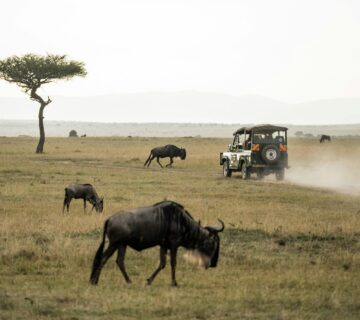
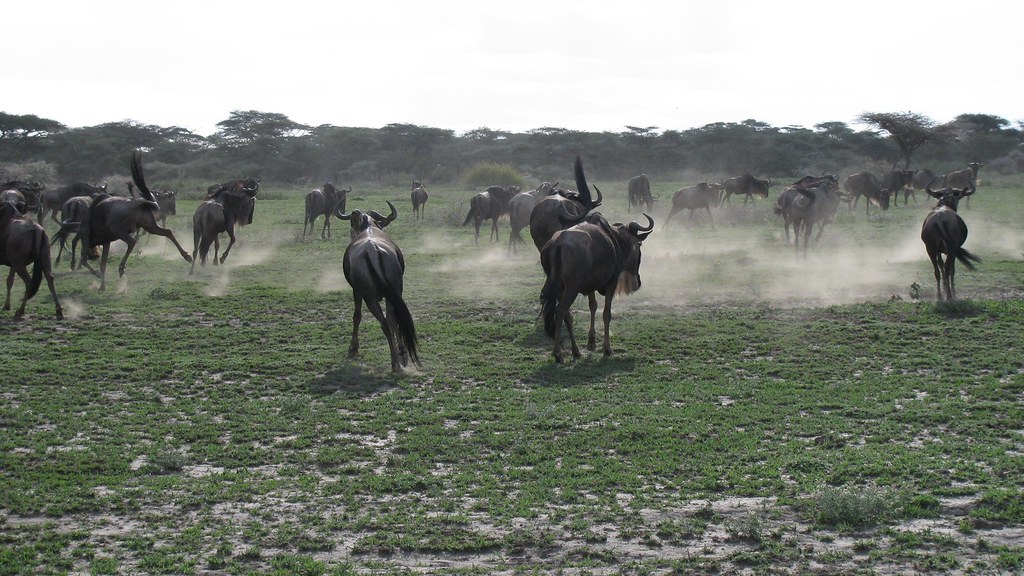
The Great Migration is not stationary. It is a constantly moving ecological system of over a million wildebeest, supported by zebras and gazelles, shifting across the plains of the Serengeti National Park and into the Masai Mara National Reserve in response to rainfall and grazing conditions. Because of this movement, camp performance is entirely dependent on timing and positioning rather than brand, luxury level, or price.
A camp that delivers exceptional sightings in one month may be completely quiet a few months later. This is why experienced safari planners do not talk about “best camps” in isolation. They talk about zones, seasons, and positioning.
Understanding this shift in thinking is the key to planning a successful Great Migration safari.
Why Camp Positioning Matters More Than Camp Luxury
One of the most common mistakes travellers make is assuming that luxury automatically equals better wildlife viewing. While comfort matters for the overall safari experience, it has very little influence on whether you actually see the migration.
The real determining factor is location relative to the herds at a specific time of year. Safari camps inside the Serengeti are strategically placed in different regions to align with expected wildlife movement patterns. These placements are based on decades of ecological observation, not convenience.
Because the migration is seasonal and fluid, no single camp stays in the “best position” all year. Instead, each zone becomes important during a specific phase of the cycle. This means a mid-range camp perfectly positioned in the right region will often outperform a luxury camp that is geographically out of sync with the herds.
Understanding this principle is essential before comparing camps.
Northern Serengeti: The River Crossing Stronghold
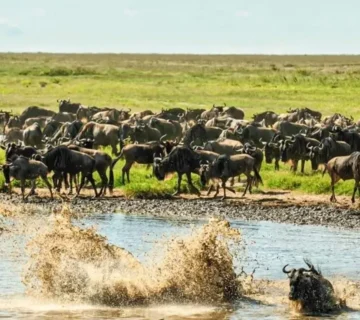
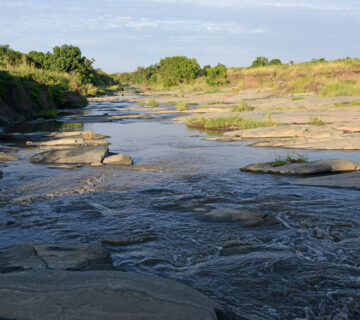
The northern Serengeti is the most famous migration region because it hosts the dramatic Mara River crossings between roughly July and October. This area forms the final barrier before the herds enter the Masai Mara National Reserve, and it is where some of the most intense wildlife scenes in Africa occur.
Camps in this region are typically positioned around key crossing points such as Kogatende and Lamai. These locations are not random. They are selected specifically because they are close to river sections where wildebeest gather in large numbers before attempting to cross.
The challenge in this zone is unpredictability. The herds may gather for days before crossing or move rapidly depending on pressure from predators and weather conditions. Camps located close to the river significantly reduce travel time, allowing guests to respond quickly when movement begins.
Mobile camps are particularly important here. These camps relocate seasonally to stay near active crossing points. Their mobility gives them a major advantage in maintaining proximity to the migration during peak months. However, because they are small and seasonal, they often book out long in advance.
The northern Serengeti represents the highest concentration of demand in the entire migration system. Availability here is extremely limited, especially for camps directly overlooking or within short driving distance of the Mara River.
Central Serengeti: The Reliable Wildlife Corridor
The central Serengeti, particularly the Seronera Valley, is the most stable wildlife region in the entire ecosystem. Unlike the northern or southern zones, it is not defined by a single dramatic seasonal event. Instead, it functions as a permanent wildlife hub throughout the year.
This region plays a critical role in the migration cycle because it acts as a transition corridor. Between April and June, large sections of the herds pass through central Serengeti as they move north. In November, the return migration also flows through this area as animals head back to southern plains.
Even when the migration is elsewhere, central Serengeti maintains strong resident wildlife populations. Lions, leopards, elephants, and buffalo remain active year-round, making it one of the most consistently rewarding safari regions in Africa.
Camps in this area are less dependent on precise timing. While they may not offer the drama of river crossings or calving season concentrations, they provide reliable game viewing across multiple species regardless of migration position.
For travellers who prioritize consistency over peak spectacle, central Serengeti offers the most balanced experience.
Southern Serengeti: The Calving Season Epicenter
The southern plains of the Serengeti are transformed between December and March into one of the most productive wildlife breeding grounds in the world. This is where the calving season takes place, and where the majority of wildebeest births occur within a short window of time.
This region is defined by short grass plains that provide nutrient-rich grazing after seasonal rains. It is here that hundreds of thousands of calves are born almost simultaneously, creating a sudden explosion of life across the landscape.
This concentration of newborns attracts intense predator activity. Lions, cheetahs, hyenas, and jackals closely follow the herds, resulting in frequent and often dramatic hunting interactions.
Camps in this zone are often positioned around areas like Ndutu, which sits between the southern Serengeti and the Ngorongoro ecosystem. This transitional geography allows access to both open plains and wooded areas, increasing wildlife diversity.
Many camps here are seasonal, operating only during the calving months. They are placed specifically to maximize proximity to birthing herds and predator zones. This makes the southern Serengeti one of the most strategically important regions for early-year migration safaris.
The advantage of this zone is intensity. Wildlife encounters are frequent, dense, and highly active over a relatively short period.
Mobile Camps: Following the Migration in Real Time
Mobile camps represent the most direct way to align accommodation with the migration itself. Instead of remaining fixed in one location, these camps move between regions depending on herd movement.
Typically, mobile camps operate in the southern Serengeti during calving season and then relocate to the northern Serengeti during river crossing season. This allows them to maintain close proximity to the herds throughout the year.
Because they are designed for mobility rather than permanence, they are often smaller and more limited in capacity than fixed lodges. However, their positioning advantage is significant. They are frequently closer to actual wildlife movement corridors than permanent camps, especially during peak migration phases.
For travellers whose primary goal is proximity to the migration rather than fixed luxury infrastructure, mobile camps often represent the most effective option.
The Hidden Rule of Serengeti Camp Selection
The most important rule in Great Migration planning is simple but often overlooked: timing defines value more than luxury.
A perfectly located camp during the right migration phase will outperform a more expensive camp that is out of position. This is because wildlife density is not evenly distributed across the Serengeti. It concentrates heavily in specific regions at specific times.
For example, a camp in northern Serengeti during July to October can provide direct access to river crossings. The same camp in February may be far from any significant migration activity. Meanwhile, a southern Serengeti camp during calving season can offer extraordinary predator interactions that are not present elsewhere.
This shifting value system is what makes Serengeti safari planning unique. Camp selection is not static. It is dynamic and must follow ecological movement patterns.
So Which Serengeti Camp Actually Gives the Best Access?
There is no single camp that remains the best throughout the year. Instead, the answer depends entirely on the stage of the migration you are targeting.
Mobile camps offer the closest alignment with the migration as it shifts, making them highly effective for travellers who want proximity over permanence.
The key insight is that “best access” is not a fixed property of a camp. It is a temporary alignment between location and wildlife movement.
The Great Migration is not a static attraction. It is a moving system shaped by rainfall, grass growth, and survival pressure. The camps inside the Serengeti National Park are positioned to track this movement, but their effectiveness changes throughout the year.
The real skill in safari planning is not finding a universally “best” camp. It is understanding where the herds will be during your travel dates and choosing a camp that sits directly in that zone of movement.
In the end, the most important factor is not how luxurious your camp is, but how correctly it is positioned within the migration cycle. That alignment is what turns a safari from a general wildlife trip into a true Great Migration experience.
Start Planning Your Next Trip To Africa
If you can picture yourself in one—or several—of these exceptional retreats, the next move is simple. We design fully tailored African safaris that bring these experiences together seamlessly, from private gorilla encounters to luxury lodges in the heart of the wild.
Every detail is carefully planned, so your journey feels effortless from start to finish. Reach out in whichever way suits you best, and let’s begin crafting your safari.
Start Planning