Lake Mburo National Park
Uganda’s Most Accessible Safari
Location: Western Uganda, approximately 240 kilometres southwest of Kampala, near the town of Mbarara.
Lake Mburo National Park is Uganda’s smallest savannah park but one of the country’s most rewarding wildlife destinations. Covering approximately 370 square kilometres, the park is a beautiful mix of open acacia woodland, papyrus swamps, rocky ridges and five scenic lakes, with the largest giving the park its name.
The park is home to Uganda’s only population of impala alongside zebra, eland, topi, buffalo, hippos, crocodiles, and the elusive leopard. With over 350 bird species recorded, it is also a fantastic destination for birdwatchers, particularly for acacia-associated species and papyrus specialists along the lakeshore.
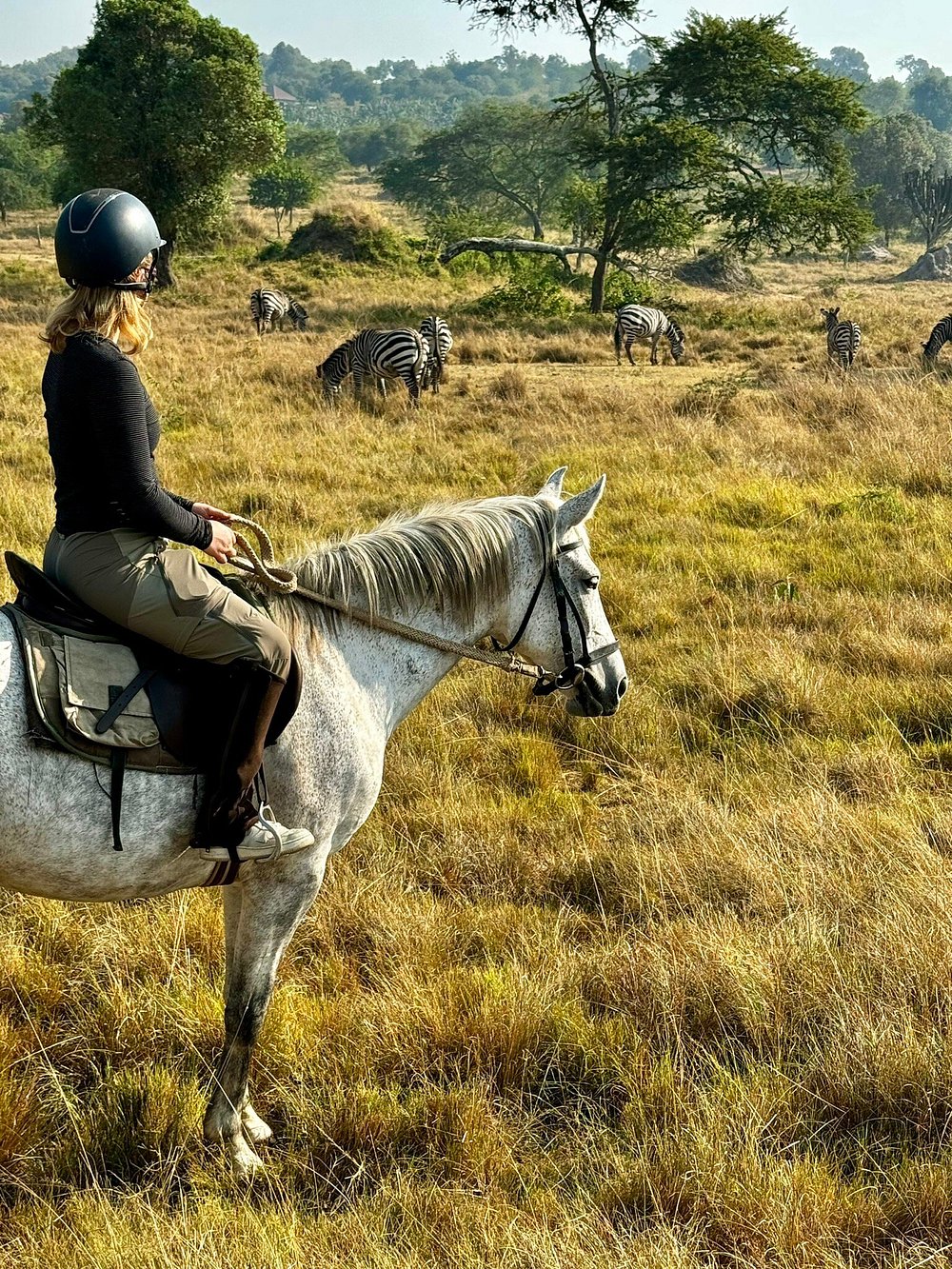
Horseback safaris by Mihingo Lodge through the acacia grasslands allow you to move quietly and closely in a way no vehicle can replicate. Guided walking safaris and game drives all offer different and equally rewarding perspectives of this compact but rich ecosystem.
Lake Mburo National Park
Game Drives in Lake Mburo National Park | Walking Safaris | Horseback & Mountain Bike Safaris | Boat Cruise on Lake Mburo | Birdwatching |Ankole Cultural Experience
Uganda’s smallest savannah national park, Lake Mburo National Park sits in the rolling hills of Kiruhura District in western Uganda, approximately 228 kilometres from Kampala and just 30 kilometres east of Mbarara. It covers approximately 370 square kilometres of mosaic habitat, encompassing five lakes, extensive papyrus wetlands, open savannah, dense acacia woodland, and ancient rocky outcrops whose Precambrian granite boulders were formed over 500 million years ago. The result is a landscape of genuine variety compressed into a park small enough to explore thoroughly in two days, yet rich enough to reward a much longer stay.
What makes Lake Mburo genuinely distinctive in the Uganda safari landscape is not what it shares with other parks, but what it offers that no other park can. It is the only place in Uganda where you can see the impala, the eland, and the klipspringer. It is the only easily accessible location in the country for Burchell’s zebra. And because the park has no elephants and a relatively low density of large predators, it is one of the safest places in East Africa for guided walking safaris, horseback riding, and mountain biking, activities that are simply not possible in Uganda’s larger, more predator-rich parks. For travellers driving between Kampala and Bwindi, Queen Elizabeth, or any of Uganda’s western destinations, Lake Mburo is the natural overnight stop that most guests wish they had stayed at for two nights rather than one.
About Lake Mburo National Park
The story of Lake Mburo is, in many ways, a conservation story and a deeply human one. The area was first gazetted as a controlled hunting ground in 1933, declared a game reserve in 1963, and upgraded to national park status in 1983. The decades that followed were turbulent, with significant wildlife loss through poaching and encroachment by local pastoral communities. The park never fully regained its original boundaries, but what was reclaimed has been transformed through a model of community collaboration that Uganda Wildlife Authority now holds up as an example of how people and wildlife can genuinely coexist.
The results are visible in the park today. In 2015, Uganda Wildlife Authority successfully translocated Rothschild’s giraffes from Murchison Falls National Park to Lake Mburo, and the population is now thriving across the acacia woodlands. Lions have been reintroduced as part of ongoing restoration efforts, and the broader wildlife community has flourished under improved protection and community engagement. The park is today a designated Lion Conservation Unit, a conservation designation that reflects both how far it has come and how seriously its long-term future is being managed.
The physical landscape of Lake Mburo is unlike any other park in Uganda. Because elephants were absent for many decades, the vegetation thickened into lush acacia woodland rather than the open grassland that elephant browsing typically maintains. This has created a distinctive, semi-forested savannah habitat that supports an unusual combination of species. Five lakes lie within the park boundaries, the largest of which, Lake Mburo itself, acts as the wildlife heart of the ecosystem, drawing animals to its shores in concentrations that are particularly spectacular during the dry season. The park sits in the rain shadow between the Rwenzori Mountains and Lake Victoria, giving it a drier, sunnier character than Uganda’s forested western parks, closer in aesthetic to classic East African savannah, but with a quieter, more intimate scale that is entirely its own.
Wildlife of Lake Mburo National Park
Lake Mburo’s wildlife is defined above all by exclusivity within Uganda. No other park in the country offers the same combination of species, and several of the park’s flagship animals are found nowhere else on the Uganda safari circuit.
Zebra are the park’s most iconic presence. Approximately 5,000 Burchell’s zebra roam the savannah and lake edges, gathering in striking herds that make Lake Mburo the only easily accessible zebra-viewing destination in Uganda. Their striped gatherings against golden acacia woodland are among the most photogenic safari scenes in the country.
Impala are found only in Lake Mburo within Uganda. Elegant, abundant, and constantly alert, impala herds are seen throughout the park, their chestnut coats glowing in the morning and late afternoon light.
Eland, the largest antelope on earth, inhabit the park in good numbers. Bulls can weigh over 900 kilograms yet move with surprising grace through the acacia scrub, and their size alone makes every sighting memorable.
Rothschild’s Giraffe, reintroduced in 2015, are now well established across the park’s acacia woodlands. Their presence connects Lake Mburo directly to the global conservation effort protecting this critically endangered subspecies.
Leopard are present in exceptional density for the park’s size. Lake Mburo is consistently regarded as one of the best places in Uganda to spot leopard, particularly on night game drives where these naturally elusive cats become significantly more active and visible.
Hippopotamus and Nile Crocodile are abundant in the five lakes, most easily and closely observed on the Lake Mburo boat cruise.
Buffalo, Topi, Waterbuck, Bushbuck, Warthog, Oribi, Sitatunga and Klipspringer complete a remarkably varied antelope and mammal list for a park of this size. The sitatunga, a semi-aquatic antelope, inhabits the papyrus swamps fringing the lakes and is rarely encountered elsewhere in Uganda. The klipspringer, a small, sure-footed antelope perfectly adapted to rocky terrain, is reliably seen on and around the ancient kopje outcrops within the park.
Activities in Lake Mburo National Park
Game Drives
Game drives in Lake Mburo are conducted across a network of well-maintained tracks that pass through the park’s most productive wildlife corridors. The open savannah north and east of Rwonyo, along the Research Track and the Zebra, Impala, and Warukiri tracks, consistently produces the best wildlife concentrations. Zebra and impala gather in large herds along these routes, buffalo move in dense groups across the grassland, and the acacia woodland edges are productive for topi, waterbuck, and bushbuck.
For panoramic views, a drive to the Kazuma Lookout rewards guests with one of the finest vistas in the park, a high ridge from which eight of the thirteen lakes in the Mburo-Nakivale system are visible, the surrounding hills and acacia valleys stretching in every direction. It is particularly spectacular at sunset.
Night game drives are one of Lake Mburo’s great specialities, and the park is among the few in Uganda where they are regularly conducted. After dark, the park transforms entirely. Leopards become active and visible along the woodland edges and rocky outcrops. Spotted hyenas move across the open grassland. Bush babies launch between branches with enormous reflective eyes. White-tailed mongooses, side-striped jackals, and various owl species emerge from the undergrowth. Given the park’s exceptionally high leopard density, a night game drive at Lake Mburo offers one of the most realistic chances of a leopard sighting anywhere in Uganda.
Lake Mburo Boat Cruise
The Lake Mburo boat cruise is one of the park’s most consistently rewarding activities, a gentle and wildlife-rich journey across the lake’s calm waters that delivers encounters simply not possible from a vehicle. Hippos are the dominant presence, surfacing and bellowing alongside the boat in extraordinary proximity. Nile crocodiles bask on the lake shores. The African finfoot, one of Africa’s shyest and most sought-after waterbirds, is regularly spotted along the papyrus-fringed edges of the lake. Fish eagles call from overhanging trees, saddle-billed storks stride through the shallows, and the papyrus margins provide habitat for the shoebill stork and numerous papyrus-specialist bird species.
The late afternoon departure is particularly atmospheric. The light on the water turns gold as the sun drops, hippos silhouette against the glowing horizon, and the lake comes alive with evening birdsong and the distant calls of animals beginning to move toward the water for the night.
Walking Safaris
Because the park lacks elephants and has a low density of large predators, Lake Mburo is one of the safest places in East Africa to explore on foot, and walking here offers an intimacy with the landscape that no vehicle can replicate. All guided walks are accompanied by an armed Uganda Wildlife Authority ranger and can be conducted across various parts of the park.
The salt lick area is a particularly rewarding destination for walks, where a hidden wooden platform has been constructed overlooking the natural salt deposit. Zebras, impalas, and other park animals visit regularly, and the ability to observe them from ground level at close range, in silence, is one of those quietly extraordinary safari moments that stays with guests long after the more dramatic encounters have faded.
Swamp walks include raised platforms overlooking the papyrus marshes, where patient visitors may encounter the sitatunga picking through the reeds, or spot the prehistoric silhouette of the shoebill stork moving through the swamp.
Horseback Safari
Lake Mburo is the only national park in Uganda where horseback safaris are offered, and it is a genuinely extraordinary way to experience the wildlife. Animals are far more relaxed around horses than around vehicles. Zebras graze calmly nearby, impalas barely register the approach, and even the naturally shy eland come closer than they ever would to a safari car. The absence of lions and elephants makes the experience safe and genuinely immersive. You are in the landscape rather than observing it, moving at the pace of the animals around you.
Horseback safaris are operated by Mihingo Lodge in the eastern part of the park and are tailored to individual experience and riding ability. Children can be led on calm, well-tempered ponies while experienced riders can take on longer, more demanding routes through the savannah and woodland. Both day and night horseback safaris are available, with the night ride offering a particularly atmospheric and unusual way to experience the park after dark.
Cycling Safari
Cycling through Lake Mburo connects you to the landscape in a way that neither a vehicle nor a walking safari quite replicates. Trails run primarily along flat valley bottoms where wildlife is abundant and visibility across the grassland is excellent. All rides are guided and can be tailored to duration, from a one-hour introductory circuit to a longer half-day ride through multiple wildlife corridors. The wildlife encounters on a bicycle are often startlingly close. Zebras grazing metres from the trail barely look up, impalas move alongside without alarm, and warthogs trot ahead with their tails raised in characteristic fashion. It is one of the most enjoyable and underrated ways to spend a morning in Lake Mburo.
Birdwatching
With over 350 recorded bird species across its remarkable mosaic of habitats, Lake Mburo is one of western Uganda’s premier birdwatching destinations and one that is significantly underrated in the broader East Africa birding circuit. The variety of habitat types compressed within a relatively small area, open savannah, dense acacia woodland, papyrus swamp, lake shore, and rocky outcrop, supports an equally extraordinary range of avian life.
The African finfoot is reliably encountered on the boat cruise along the papyrus-fringed lake edges. The shoebill stork inhabits the swampy lake margins and is a realistic target with an experienced guide. Around the Rwonyo area, acacia-associated species thrive: the mosque swallow, black-bellied bustard, bare-faced go-away bird, Rüppell’s starling, southern ground hornbill, and black-throated barbet are all regularly seen. The red-faced barbet, an East African endemic, is one of the park’s most sought-after species. The papyrus gonolek, African fish eagle, malachite kingfisher, grey crowned crane, and African grey hornbill round out a bird list that consistently impresses visiting birders.
A dedicated birding guide can be arranged through any of the park’s lodges and will dramatically increase both your species count and the quality of each individual encounter.
Ankole Cultural Experience
Lake Mburo sits within the traditional territory of the Bahima people, an ancient cattle-keeping community whose identity and culture are inseparable from the magnificent Ankole long-horned cattle they have herded across these hills for centuries. These extraordinary animals, with horns that can span well over a metre, are symbols of wealth, beauty, and social status in Bahima culture, and encountering them on the road between Kampala and the park, herded through the late afternoon light by Bahima pastoralists, is one of the most visually arresting sights in rural western Uganda.
Guided visits to local Bahima homesteads offer a genuine and warm insight into this way of life. Guests can try traditional hand-milking into a wooden vessel called an ebyanzi, taste local dishes, observe the daily rhythms of cattle culture, and experience the legendary hospitality of a community proud of its heritage. It is one of the most human and culturally enriching additions to any Lake Mburo itinerary.
Sport Fishing
Lake Mburo is home to six fish species, including the common tilapia and the remarkable lungfish, and sport fishing is conducted at the designated Mazinga landing site on the lake shore. Fishing permits are available through Uganda Wildlife Authority. It is a peaceful and genuinely enjoyable activity, well-suited to guests looking for a quiet morning on the water, and a particularly good option for families travelling with children who want something different from the standard game drive format.
Best Time to Visit Lake Mburo National Park
Lake Mburo can be visited year-round and, given its compact size and high wildlife density, delivers reliable and rewarding encounters in every season.
Dry Season: June to August and December to February (Recommended)
The dry seasons are the prime months for game viewing at Lake Mburo. As water sources away from the lakes diminish, wildlife concentrates around the lake shores and remaining wetlands in spectacular numbers. Zebra and impala herds gather in dense concentrations near the water, creating some of the most photogenic safari scenes in Uganda. Vegetation thins across the savannah, opening up sightlines and making wildlife easier to spot across wider distances.
Game drive tracks are in their best condition, and the horseback and cycling safaris are most comfortable in dry, firm conditions. June to August is peak season, and accommodation should be booked well in advance.
Green Season: March to May and October to November
The rains bring a dramatic transformation to Lake Mburo. Rolling hills turn vividly green, the papyrus swamps fill and come alive, and the lakes reflect a sky that shifts constantly between sun and cloud. Migratory bird species arrive from October, significantly expanding the park’s already impressive bird list and making the green season the finest time of year for dedicated birdwatching.
The park is noticeably quieter, some lodge rates are lower, and the landscape photography is outstanding. Game drives remain productive throughout, though a capable 4WD vehicle is essential on the park’s dirt access roads during heavier rainfall.
Getting to Lake Mburo National Park from Kampala
By Road
Lake Mburo is the closest national park to Kampala, making it the most accessible safari destination in Uganda by a significant margin. The drive covers approximately 228 kilometres along the well-paved Kampala-Mbarara highway and takes around three and a half hours under normal conditions. The route passes through some of western Uganda’s most characteristic scenery: papyrus swamps, banana plantations, Ankole cattle country, and the rolling hills of the western region.
It is one of the most manageable drives on the entire Uganda safari circuit and can easily be completed on the same afternoon as departing Kampala, allowing for an evening game drive or boat cruise on arrival day.
The park is accessible through two gates from the main highway. The Nshara Gate in the north is the most commonly used for guests arriving from Kampala, located approximately five kilometres from the main road. The Sanga Gate in the northeast is better suited for guests approaching from western Uganda or returning from Bwindi Impenetrable National Park. Both access roads from the highway are unpaved and can be rough after heavy rain, so a 4WD vehicle is advisable.
Combining Lake Mburo with Other Destinations
Lake Mburo’s position on the main Kampala-western Uganda highway makes it the natural connector between the capital and Uganda’s more remote safari destinations. Most guests encounter it as part of a longer itinerary rather than as a standalone destination, and it fits seamlessly into almost any Uganda circuit.
Bwindi Impenetrable National Park for gorilla trekking is approximately four to five hours southwest of Lake Mburo, making it the classic pairing. Guests who break the long Kampala-Bwindi drive with one or two nights at Lake Mburo arrive at the gorilla forest rested, having already had outstanding wildlife encounters along the way.
Queen Elizabeth National Park is approximately three hours west via Mbarara and Kasese, and a combined Lake Mburo and Queen Elizabeth itinerary covers an exceptional range of Uganda’s savannah wildlife in a relatively compact circuit. For guests beginning or ending their Uganda trip at Entebbe, Lake Mburo at just three and a half hours from the airport is the ideal first or last safari night, easing travellers into or out of the wider Uganda experience without a demanding drive on arrival or departure day.
Where To Find It
LOCATION
Luxury Lodges In Lake Mburo National Park
Uganda Travel Advice
Tented Camp vs Fixed Lodge in Uganda
Is It Worth Visiting Uganda in the Rainy Season For Safaris?
Uganda’s Tree-Climbing Lions of Ishasha
Driving from Entebbe to Bwindi
Gorilla Habituation vs Gorilla Trekking