River Crossings vs Calving Season: Which Part of the Great Migration Is Worth Travelling For?
Two Most Dramatic Phases of the Great Migration
The Great Migration is not a single event but a continuous, circular movement of over 1.5 million wildebeest, accompanied by hundreds of thousands of zebras and gazelles, moving through the ecosystems of the Serengeti–Mara ecosystem between Tanzania and Kenya. Two moments dominate global safari interest more than any others: the river crossings at the Mara River and the calving season in the southern Serengeti plains.
Both are visually spectacular, emotionally intense, and ecologically significant, yet they deliver completely different safari experiences. Choosing between them is not simply a matter of “which is better,” but rather “what kind of wildlife experience you want to have.”
The river crossings are about tension, chaos, survival, and raw drama. The calving season is about abundance, new life, and predator-prey dynamics on open plains. One feels like a battlefield at the edge of a river. The other feels like a nursery under constant surveillance by predators.
To understand which one is worth travelling for, it is essential to break down timing, location, wildlife behaviour, viewing conditions, accessibility, and emotional impact.
What Happens During the River Crossings
The river crossings are most famously associated with the Mara River system, particularly within and around the ecosystem of Masai Mara National Reserve in Kenya and the northern parts of the Serengeti ecosystem in Tanzania, including areas bordering Serengeti National Park.
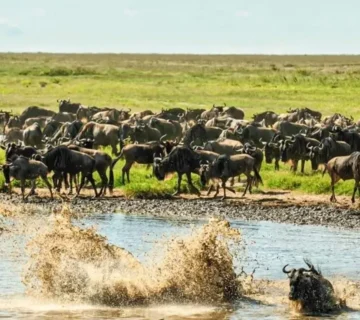
This phase typically occurs between July and October, although exact timing varies each year depending on rainfall and grazing pressure. During this period, massive herds of wildebeest gather on the southern banks of the Mara River, hesitating for hours or even days before attempting to cross into Kenya.
The challenge is not just the water itself but what lies within it. Crocodiles lie submerged, waiting. Strong currents can sweep animals away. Steep riverbanks create bottlenecks where panic leads to stampedes. It is not uncommon for crossings to involve thousands of animals surging forward at once after long periods of hesitation.
The experience for travellers is defined by unpredictability. You may wait for days without seeing a crossing, or you may witness multiple crossings in a single day. When it happens, it lasts minutes, sometimes less than an hour, but the intensity is unmatched in wildlife viewing anywhere in the world.
What Happens During the Calving Season
The calving season takes place primarily between January and March in the southern Serengeti plains, especially around Ndutu and surrounding areas within the ecosystem of Serengeti National Park.
This period is driven by the rains that turn the short-grass plains into nutrient-rich grazing grounds. The wildebeest arrive in enormous numbers to give birth almost synchronously. Around 400,000 calves are born within a span of just a few weeks.
Unlike the chaos of river crossings, calving season is defined by stillness and repetition. You see thousands of newborn calves standing unsteadily on the plains within minutes of birth. Mothers stay close, forming dense protective groups.
However, this is also predator heaven. Lions, cheetahs, hyenas, and jackals are highly active because vulnerable newborns are abundant and easy targets. The predator-prey interactions are frequent, visible, and often dramatic, but they unfold in open landscapes rather than chaotic river scenes.
The Emotional Contrast Between the Two Experiences
The river crossings are emotionally intense in a sudden, explosive way. You are watching survival under pressure. There is fear, urgency, and unpredictability. The tension builds slowly as herds gather, then releases in a chaotic surge. Many travellers describe it as overwhelming, even distressing, because of the visible struggle and occasional losses.
Calving season is emotionally different. It is less about shock and more about immersion. You see life beginning constantly. You also see predation, but it is framed within the natural cycle of life on the plains. Instead of sudden chaos, there is a continuous rhythm of birth, movement, and survival learning.
One is dramatic theatre. The other is biological abundance.
Wildlife Density and Viewing Opportunities
During river crossing season, wildlife is extremely concentrated at specific bottlenecks along the Mara River. This creates high-impact viewing moments, but also means you may spend significant time waiting in fewer productive locations.
The advantage is that when activity happens, it is concentrated and unforgettable. You may see thousands of wildebeest crossing at once, followed by predators attempting ambushes at the river edges.
During calving season, wildlife is spread across vast plains, but density is still extremely high. Instead of one dramatic focal point, you encounter continuous sightings across the landscape. Wildebeest herds stretch to the horizon, interspersed with zebras, gazelles, and predators patrolling territories.
In practical terms, calving season offers more consistent sightings per day, while river crossings offer fewer but more explosive moments.
Predator Behaviour Differences
Predators behave differently in each season due to changes in prey vulnerability and distribution.
During river crossings, crocodiles dominate the predator narrative. They are the most visible and consistent hunters in the water. On land, lions and hyenas wait near crossing points, but actual hunts are less frequent because chaos is concentrated in short bursts.
During calving season, the predator-prey relationship becomes more dynamic across the entire landscape. Lions operate in coordinated prides targeting weak or isolated calves. Cheetahs take advantage of open visibility to chase young wildebeest at high speed. Hyenas form large clans that track herds continuously.
If your interest is predator strategy and frequent hunt opportunities, calving season provides a broader range of observable behaviours.
Landscape and Photographic Conditions
The river crossing environment is visually dramatic but geographically constrained. Riverbanks are often crowded with vehicles during peak moments, and photography can be challenging due to dust, movement, and unpredictable timing. However, when crossings occur, the water, chaos, and animal density create powerful action photography opportunities.
Calving season offers cleaner photographic conditions. The southern Serengeti plains are wide, open, and green. Lighting is often softer due to seasonal cloud cover and morning mist. This creates ideal conditions for landscape wildlife photography, especially wide-angle shots of herds, newborn calves, and predator interactions.
In simple terms, river crossings are better for action shots, while calving season is better for composition, lighting, and storytelling imagery.
Accessibility and Safari Logistics
River crossing safaris require strategic positioning in the northern Serengeti or the southern parts of the Masai Mara ecosystem. Timing is critical, and camps near river crossing points tend to be fully booked well in advance. Mobility and flexibility are essential because crossing locations shift depending on herd movement.
Calving season safaris are generally easier to plan. The southern Serengeti plains offer more predictable wildlife concentrations, and lodges in the Ndutu region can provide reliable access to large herds. Game drives are often shorter in distance but richer in continuous sightings.
From a logistics standpoint, calving season is more predictable and comfortable, while river crossings require more patience and flexibility.
Crowd Levels and Safari Exclusivity
River crossing season is the busiest period in East African safari tourism. The concentration of vehicles near crossing points can be high, especially during peak migration weeks. This can affect the sense of wilderness immersion, although the wildlife spectacle often outweighs the crowding.
Calving season is less crowded overall. While popular among seasoned safari travellers and photographers, it does not attract the same mass concentration of vehicles as river crossings. This allows for more relaxed game drives and a stronger sense of space.
If exclusivity matters, calving season generally offers a more private experience.
Weather Conditions and Comfort
River crossing season occurs during the dry season. Conditions are typically dusty, with clear skies and cooler mornings. This improves visibility but can reduce colour saturation in landscapes.
Calving season occurs during the green season, when short rains have transformed the plains into lush grazing areas. The environment is greener, more vibrant, and more visually dynamic, but occasional rain showers can affect road conditions and accessibility.
For comfort, dry season is easier. For visual richness, green season is superior.
Scientific and Ecological Significance
From an ecological perspective, calving season is arguably the most important phase of the migration cycle. It represents the reproductive engine of the entire system. The synchronized births are a survival strategy designed to overwhelm predators through sheer numbers, ensuring population continuity.
River crossings, on the other hand, are driven by resource scarcity and grazing pressure. They represent movement across ecological boundaries, especially the search for fresh pasture and water access. The river becomes a natural barrier that shapes survival patterns.
Both are essential, but calving is about regeneration while crossing is about survival under pressure.
Which Experience Feels More “Authentic”
Authenticity in safari terms depends on what aspect of wilderness you value.
River crossings feel raw and unfiltered. You are witnessing survival decisions under extreme pressure. There is unpredictability and intensity that cannot be staged or replicated.
Calving season feels expansive and continuous. You are immersed in a life cycle happening at massive scale, where every moment contributes to the broader ecological rhythm.
Neither is more authentic. They are simply different expressions of the same migration system.
Which One Should You Choose
If your priority is dramatic wildlife action, high tension, and iconic “bucket-list” safari moments, river crossings in the northern Serengeti and Masai Mara ecosystem deliver unmatched intensity. It is the most famous wildlife spectacle in Africa for a reason.
If your priority is consistent wildlife viewing, predator interactions, newborn wildlife, photographic quality, and fewer crowds, calving season in the southern Serengeti offers a more immersive and balanced safari experience.
The most important truth is that both are part of the same cycle. The migration does not pause for tourism seasons. It moves, adapts, and responds to rainfall and grazing pressure.
For many experienced safari travellers, the ideal answer is not choosing one over the other, but experiencing both at different stages of life or travel planning.
Start Planning Your Next Trip To Africa
If you can picture yourself in one—or several—of these exceptional retreats, the next move is simple. We design fully tailored African safaris that bring these experiences together seamlessly, from private gorilla encounters to luxury lodges in the heart of the wild.
Every detail is carefully planned, so your journey feels effortless from start to finish. Reach out in whichever way suits you best, and let’s begin crafting your safari.
Start Planning