Great Migration 2026: Exactly When and Where to Be in the Serengeti Each Month
How the Great Migration Really Works
The Great Migration in Tanzania is not a single event that happens at a fixed time or place. It is a continuous, circular movement of more than 1.5 million wildebeest, supported by hundreds of thousands of zebras and gazelles, moving across the Serengeti–Mara ecosystem in response to rainfall and fresh grazing.
What makes it complex is that the migration changes location every few weeks. If you are in the wrong part of the Serengeti at the wrong time, you may miss it entirely. If you are in the right region, you can experience one of the most dramatic wildlife spectacles on earth, including calving season, predator action, or river crossings.
This month-by-month guide for 2026 explains exactly where to be in the Serengeti so you can match your safari dates with the right stage of the migration.
January: Southern Serengeti and Ndutu Plains Begin the Calving Period
In January, the migration is concentrated in the southern Serengeti and Ndutu area within the Ngorongoro Conservation Area. This region offers short grass plains that are rich in nutrients after the rains, attracting massive herds of wildebeest and zebra.
During this time, the landscape is open and green, and wildlife is spread across wide plains. The migration is not about movement in January but about settling and grazing.
Predator activity begins to increase as lions, cheetahs, hyenas, and leopards follow the herds closely. This creates constant interaction between hunters and vulnerable animals.
January is ideal for travelers who want high wildlife density and early calving preparation behavior.
February: Peak Calving Season in Southern Serengeti
February is the most intense month of the calving season. Hundreds of thousands of wildebeest calves are born within a very short window, making it one of the most dramatic wildlife events in Africa.
The southern Serengeti becomes extremely active with life and death interactions happening daily. Predators take advantage of the abundance of newborns, leading to frequent hunts and high-action game viewing.
This is one of the best months for photography because of the combination of green landscapes, newborn animals, and constant predator presence.
If your goal is dramatic wildlife behavior rather than migration movement, February is one of the most rewarding months in the entire year.
March: End of Calving and Early Northward Movement
By March, calving activity slows down and herds begin preparing to move north. While many animals are still in the southern plains, the migration starts spreading toward central Serengeti.
Wildlife is still abundant, but less concentrated than in February. Predator activity continues, but movement becomes more noticeable as herds gradually shift location.
March offers a balance between calving season intensity and the beginning of migration movement, making it a transitional but rewarding safari month.
April: Movement Into Central Serengeti
In April, the migration begins moving into the central Serengeti. This is a transitional stage where herds are no longer concentrated in one area but are slowly dispersing northward.
Rainfall increases across the Serengeti, creating lush green landscapes and wide grazing areas. Wildlife is still active, but more spread out compared to southern calving months.
Game viewing becomes more dynamic and less predictable because herds are constantly on the move. Predator sightings remain strong as lions and hyenas follow the migrating groups.
April is also a quieter tourism month, which means fewer safari vehicles and a more private experience in the parks.
May: Western Serengeti and Grumeti Region Movement
In May, the migration reaches the western Serengeti, especially the Grumeti River region. This area introduces the first major river challenges of the migration cycle.
Herds begin crossing water channels where crocodiles wait, although crossings are less predictable than later in the year. Movement is continuous as animals search for fresh grazing.
The landscape is at its greenest, making May one of the most visually striking months of the year.
Wildlife viewing depends heavily on rainfall and herd movement, so flexibility in safari planning is important during this period.
June: Western Corridor Peak and Building Momentum North
June marks a key transition as the migration gathers momentum toward the northern Serengeti. Herds concentrate in the western corridor while preparing for longer movement phases.
This is also a time when wildebeest begin forming larger groups again after the calving dispersal period. Movement becomes more directional and organized.
Predator activity remains strong as lions and hyenas track herd movements across the plains.
June is a strategic month for travelers who want migration activity without peak season crowds.
July: Arrival in Northern Serengeti and Start of Mara River Drama
By July, the migration reaches the northern Serengeti, particularly areas like Kogatende and Lamai. This is when the most famous stage of the migration begins: the Mara River crossings.
Herds gather near riverbanks and may stay for days before attempting crossings. This waiting period is part of the natural behavior, driven by instinct and pressure from predators.
The atmosphere becomes tense and dramatic. Crocodiles remain in the water, predators wait along the banks, and thousands of animals prepare for potential crossings.
July is the beginning of one of the most iconic wildlife experiences in the world, but crossings are not guaranteed and require patience.
August: Peak Mara River Crossing Season
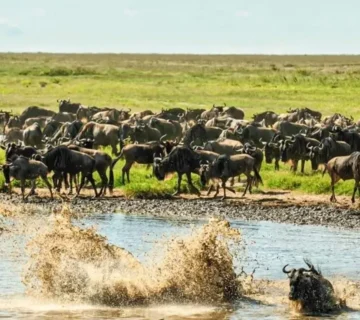
August is widely considered the peak month for Mara River crossings in the northern Serengeti. This is when crossings are most frequent and large in scale.
Herds move between Tanzania and Kenya, crossing dangerous river sections filled with crocodiles. The events are chaotic, unpredictable, and highly dramatic.
Some crossings happen multiple times per day, while others may not occur for several days. This unpredictability is part of what makes the experience so powerful.
August is the busiest safari month in the northern Serengeti because of the high probability of witnessing river crossings.
September: Continued Northern Movement Between Serengeti and Maasai Mara
In September, the migration continues between the northern Serengeti and the Maasai Mara in Kenya. River crossings still occur, but herd distribution becomes more spread out.
Wildlife viewing remains excellent, with large herds still present in both regions. Predator activity continues as lions and hyenas follow movement patterns across the border.
September is slightly less intense than August but still offers strong migration activity.
October: Gradual Return Toward Central Serengeti
By October, the migration begins slowly moving back toward the Serengeti as rainfall patterns shift and grazing conditions change.
Herds start dispersing from the northern regions and begin re-entering central areas. Movement is steady but less concentrated compared to river crossing months.
This is a transitional phase where wildlife is widely distributed across the ecosystem.
November: Central Serengeti Regrouping Phase
In November, herds gather again in the central Serengeti. This regrouping phase prepares the migration for its return to the southern plains.
Rainfall begins to return to the southern regions, slowly drawing the herds back.
Wildlife viewing remains strong, although the dramatic events of river crossings and calving are not present during this month.
December: Return to Southern Serengeti and Ndutu Plains
By December, the migration completes its annual cycle and returns to the southern Serengeti and Ndutu region.
Fresh rains create nutrient-rich grazing conditions, attracting large herds back to the plains. This sets the stage for the next calving season starting in early the following year.
December is a transition month that reconnects the migration cycle back to its beginning.
Timing Is Everything in the Serengeti Migration
The Great Migration is not about one destination or one moment in time. It is a continuous movement shaped by rainfall, grazing patterns, and survival instincts.
Each month in the Serengeti offers a completely different version of the migration, from calving season in the south to river crossings in the north and transition periods in between.
The key to experiencing it properly is not luck, but timing. Being in the right region at the right month determines whether you witness quiet grazing herds or dramatic river crossings.
In 2026, planning your safari around these movement patterns is the difference between seeing the migration and truly experiencing it.
Start Planning Your Next Trip To Africa
If you can picture yourself in one—or several—of these exceptional retreats, the next move is simple. We design fully tailored African safaris that bring these experiences together seamlessly, from private gorilla encounters to luxury lodges in the heart of the wild.
Every detail is carefully planned, so your journey feels effortless from start to finish. Reach out in whichever way suits you best, and let’s begin crafting your safari.
Start Planning