Queen Elizabeth National Park
Uganda’s Most Biodiverse Safari Destination
Location: Southwestern Uganda, stretching across the Albertine Rift Valley between Lake George and Lake Edward.
Queen Elizabeth National Park is Uganda’s most popular wildlife destination, covering nearly 2,000 square kilometres of diverse habitats including savannah, wetlands, forests and lakeshores. The park is renowned for its famous tree-climbing lions in the Ishasha sector, large populations of elephants, buffaloes, hippos, leopards and more than 600 bird species. The scenic Kazinga Channel offers exceptional boat safaris with abundant wildlife viewing, while Kyambura Gorge provides opportunities for chimpanzee tracking within the park’s diverse ecosystem.
Queen Elizabeth National Park
Wildlife & Game Drives on the Kasenyi Plains | Tree-Climbing Lions of Ishasha | Kazinga Channel Boat Cruise | Chimpanzee Tracking in Kyambura Gorge | Birdwatching | Crater Lakes
The secret to Queen Elizabeth’s extraordinary wildlife diversity lies in its geography. The park sits in the floor of the Albertine Rift Valley one of the most biodiverse regions on earth and encompasses ten distinct ecosystems within its boundaries: open savannah, tropical high forest, volcanic crater lakes, freshwater wetlands, salt lakes and riverine forest. This mosaic of habitats supports an equally remarkable mosaic of wildlife and it is why Queen Elizabeth feels so different from one part of the park to another.
The Kazinga Channel, threading between Lake George and Lake Edward at the centre of the park, acts as a wildlife magnet drawing animals to its banks in enormous concentrations particularly in the dry season.
The Kasenyi Plains in the north offer classic open savannah game viewing, with large herds of Uganda kob and reliable predator activity.
The Kyambura Gorge, a dramatic sunken forest carved up to 100 metres deep into the surrounding grassland is home to a habituated chimpanzee community and represents one of the most unusual wildlife habitats in Africa.
And the Ishasha sector in the far south is known to the world for one thing: lions that climb trees.
To the west, the park borders Virunga National Park in the Democratic Republic of Congo. To the north, the Rwenzori Mountains National Park provides a dramatic backdrop. To the east, the Kyambura Wildlife Reserve and Kalinzu Forest Reserve extend the conservation landscape further creating a connected wildlife corridor of remarkable scale.
Queen Elizabeth is also a park of geological drama. Dozens of volcanic explosion craters are scattered across the landscape many filled with shimmering crater lakes of different colours and mineral compositions a landscape unlike anything else in East Africa.
Activities in Queen Elizabeth National Park
Game Drives
Game drives are the heart of the Queen Elizabeth safari experience and the park rewards them across multiple areas and times of day. Different zones offer entirely different encounters, which is why most guests combine game drives in at least two parts of the park during their stay.
The Kasenyi Plains in the north are the prime game drive territory for predator activity. Large herds of Uganda kob, the park’s most abundant antelope and the species depicted on Uganda’s national coat of arms gather here in their hundreds, attracting lions, leopards and spotted hyenas. Buffalo are abundant, elephants move through regularly, and topi are commonly seen on the open grassland. Morning game drives on the Kasenyi Plains consistently produce the park’s most dramatic predator sightings.
The Mweya Peninsula, which protrudes into the Kazinga Channel between Lakes Edward and George, offers game drives with sweeping water views, a different aesthetic to Kasenyi and excellent for elephant, buffalo, warthog and waterbird sightings at close range.
For those staying overnight, night game drives are available through select lodges with special permits and they transform the experience entirely. Leopards, which are relatively elusive during daylight hours, become significantly more active and visible after dark. Bushbabies, genets, civets, and occasionally the African wildcat are regularly encountered. If leopard is on your wishlist, a night drive is the best strategy in Queen Elizabeth.
Ishasha – The Tree-Climbing Lions
The Ishasha sector in the far south of Queen Elizabeth National Park is one of the most remarkable lion viewing destinations in the world and a pilgrimage point for safari travellers who have already seen lions in the conventional sense and want something genuinely different.
Here, in a landscape of open acacia grassland and ancient fig trees bordering the Ishasha River, the local lion population has adopted the extraordinary and globally rare habit of climbing trees draping themselves across the branches to escape the heat of the savannah below, surveying their territory from above, and occasionally descending to hunt the abundant Uganda kob that graze the plains. This behaviour is documented in only a handful of lion populations worldwide and Ishasha is by far the most accessible and reliable location to witness it.
A sighting of lions spread across the branches of a great fig tree, the Congolese hills visible in the distance beyond the river, is one of Uganda’s most iconic wildlife moments and one that stays with guests long after the safari is over. The drive to Ishasha through the park’s southern plains is beautiful in itself, passing through open acacia woodland and riverine forest with the distant shimmer of Lake Edward to the west.
Most guests visit Ishasha as part of a two-centre Queen Elizabeth itinerary: staying one or two nights in the Ishasha sector before continuing north to the Mweya area, or using it as a gateway between Queen Elizabeth and gorilla trekking in Bwindi Impenetrable National Park, just two hours further south.
Kazinga Channel Boat Cruise
The Kazinga Channel boat cruise is one of the finest boat safari experiences in Africa and for many guests, the single most memorable activity in Queen Elizabeth. The 32-kilometre channel connecting Lake George and Lake Edward is one of the greatest concentrations of wildlife on water anywhere on the continent and seeing it from the water at close range and at a gentle pace is an experience of rare quality.
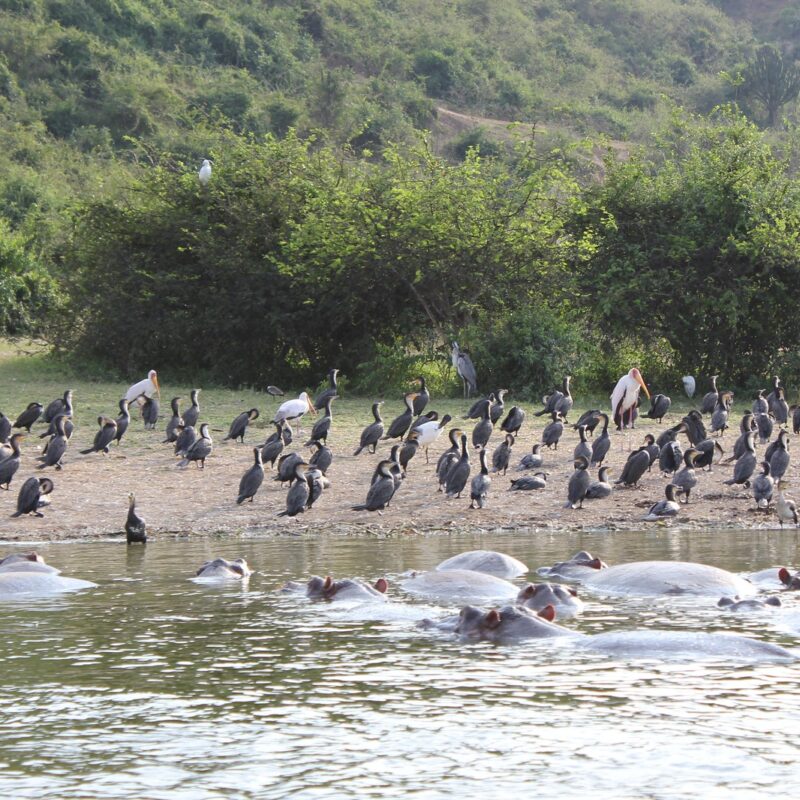
Hippos are the dominant presence sometimes hundreds of them visible simultaneously, bellowing, sparring and surfacing alongside the boat at extraordinarily close range. Nile crocodiles bask on the sandbanks. Massive buffalo herds come down to drink at the water’s edge. Elephants wade in the shallows.
And the birdlife along the channel banks is spectacular: African fish eagles, saddle-billed storks, pink-backed pelicans, pied kingfishers, malachite kingfishers, and the occasional papyrus gonolek in the reeds.
Boat trips depart in the morning and afternoon hours. The late afternoon departure is the most popular, the golden light on the water and the wildlife activity as animals come to drink in the cooling hours make it the most atmospheric of the trips. Budget approximately two hours for the full cruise.
Chimpanzee Trekking – Kyambura Gorge & Kalinzu Forest
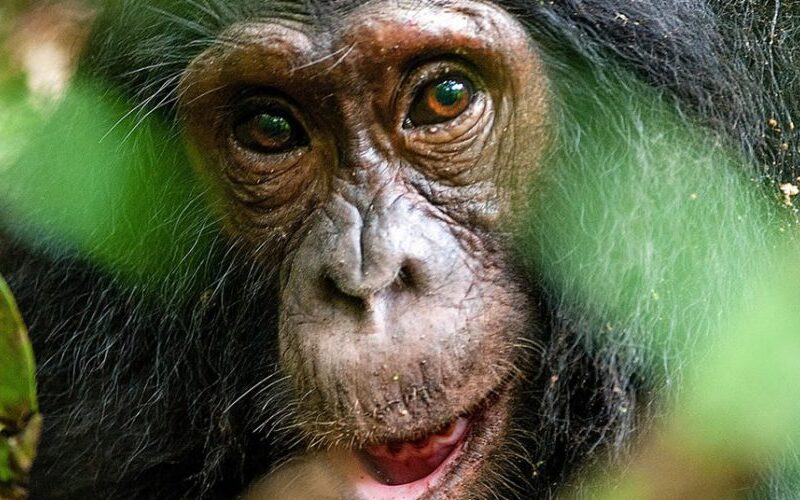
Queen Elizabeth offers two distinct and excellent chimpanzee trekking experiences, both within easy reach of the main Mweya area.
Kyambura Gorge often called the Valley of the Apes, is one of the most dramatic wildlife habitats in Africa. The Kyambura River has carved a lush, forested ravine up to 100 metres deep into the surrounding open savannah, creating an enclosed world of forest within a landscape of grassland, a visual contrast that is genuinely extraordinary.
A habituated chimpanzee community lives within this sunken forest, and trekking to find them means descending into the gorge, crossing log bridges over the river, and navigating the forest floor and canopy in search of their calls and movement. It is adventurous, atmospheric and unlike any other chimpanzee experience in Uganda.
Other primates including red-tailed monkeys, black-and-white colobus and olive baboons are commonly encountered in the gorge.
Kalinzu Forest Reserve, approximately 30 minutes from Kyambura, offers an alternative chimpanzee trekking experience in a beautiful moist tropical forest. A community of around 40 habituated chimpanzees can be tracked here, in a quieter, less visited setting.
Birdwatching
With over 600 recorded bird species, Queen Elizabeth holds the distinction of being the most species-rich national park in Africa for birds and for serious birdwatchers, it is a destination of global significance. The extraordinary diversity of habitats within the park’s boundaries supports an equally extraordinary range of avian life, from waterbirds and forest species to savannah raptors and Albertine Rift endemics.
The Kazinga Channel shores are exceptional for waterbirds: African skimmers, pink-backed pelicans, African spoonbills, goliath herons and numerous kingfisher species are all regularly seen. The Kyambura wetlands are among the best locations in Uganda for the shoebill stork one of Africa’s most sought-after birds. The Mweya Peninsula offers concentrated birding in a small area, with fish eagles, pied kingfishers and various weavers and sunbirds easily seen. Maramagambo Forest in the southeast provides forest species including the African green broadbill, various turacos and the elusive Verreaux’s eagle owl. And the open Kasenyi Plains regularly produce martial eagles, bateleurs, long-crested eagles and secretary birds soaring over the grassland.
Crater Lake Walks & Katwe Salt Works
Queen Elizabeth sits on one of East Africa’s most geologically active landscapes, and the result is a park dotted with dozens of volcanic explosion craters many of them filled with shimmering lakes of different colours and mineral compositions, each a world unto itself. Guided walks through the crater lake landscape offer a completely different kind of encounter with the park: slow, quiet and panoramic, with excellent birding opportunities and sweeping views across the Rift Valley.
The Katwe Salt Lake is one of the park’s most fascinating detours, a volcanic crater lake where local communities have been harvesting salt using traditional methods for centuries. The operation is largely unchanged from how it has always been done, and a guided visit here provides a genuinely illuminating insight into a way of life that has endured through generations.
Maramagambo Forest & Bat Cave
In the southeastern corner of the park, Maramagambo Forest is a beautiful area of moist tropical forest that feels entirely removed from the open savannah landscapes of Mweya and Kasenyi. Chimpanzees, red-tailed monkeys, and blue monkeys inhabit the forest, and the birding is outstanding with species typical of the Albertine Rift easily found here.
The forest’s bat cave is one of Uganda’s most unusual and memorable wildlife experiences: a cave whose walls and ceiling are covered by thousands of Egyptian fruit bats, hanging in dense, shifting clusters. The ecosystem within the cave is itself extraordinary pythons inhabit the cave floor, feeding on bats, while mongoose and other predators wait at the entrance.
Best Time to Visit Queen Elizabeth National Park
Queen Elizabeth can be visited year-round and the park’s sheer diversity means that something extraordinary is always happening regardless of season. That said, conditions vary across the year and the best timing depends on what you most want to experience.
Dry Season: June to September & December to February (Recommended)
These are the prime game viewing months at Queen Elizabeth. Reduced vegetation and the concentration of wildlife around permanent water sources particularly the Kazinga Channel makes animal sightings more frequent and more concentrated.
The Kasenyi Plains become particularly productive during the dry season as Uganda kob gather in large numbers and predator activity increases. Roads and tracks across the park are in better condition and the Ishasha sector is more reliably accessible. This is peak season, lodges fill quickly and should be booked well in advance.
Green Season: March to May & October to November
The rainy seasons bring a dramatic transformation to the park, lush green savannah, waterfalls cascading into the crater lakes and the Kazinga Channel banks bursting with vegetation. Migratory birds arrive in significant numbers from October onwards, making this period exceptional for birdwatching, with species counts often higher than at any other time of year.
The park is quieter, rates at some properties are lower and the landscape is genuinely beautiful. Tracks in the Ishasha sector can become muddy and challenging in heavier rains, a 4WD vehicle is essential.
For birders and travellers who prefer a quieter, more atmospheric experience, the green season is deeply rewarding.
Year-Round Highlights:
The Kazinga Channel boat cruise is outstanding in every season. Chimpanzee trekking in Kyambura Gorge and Kalinzu is available throughout the year. Tree-climbing lion sightings in Ishasha are possible in any month.
Getting to Queen Elizabeth National Park
From Entebbe or Kampala by Road
Queen Elizabeth National Park is approximately 5 to 6 hours from Kampala by road, one of the more manageable drives to any major Uganda safari destination, and one that passes through some of the country’s most scenic terrain. The route runs southwest through Masaka and Mbarara before continuing into the Rift Valley escarpment, with the park entrance near Kasese in the northwest or Ishasha in the south.
The road journey is very manageable as a single day’s drive, departing Kampala in the morning and arriving in time for an afternoon activity. Most guests combine the drive with a brief stop at the equator monument at Kayabwe, a small but satisfying landmark on any Uganda itinerary.
From Entebbe by Scheduled Domestic Flight
For guests who prefer to minimise road time, scheduled flights are available from Entebbe International Airport to two airstrips within or near the park:
- Mweya Airstrip – the most convenient option for lodges on the Mweya Peninsula and for access to the Kazinga Channel and Kasenyi game drive areas. Flight time approximately 45 minutes from Entebbe.
- Kasese Airstrip – slightly further from the park’s core, but useful for lodges in the northern part of the park. Flight time approximately 45 minutes from Entebbe.
Scheduled flights are operated by Aerolink Uganda and can be booked as scheduled or private charters. Flying in allows for an afternoon activity on arrival day making a significant difference on shorter itineraries.
Combining Queen Elizabeth with Other Uganda Destinations
Queen Elizabeth sits at the geographic heart of Uganda’s safari circuit and combines naturally with several other major destinations:
- Kibale National Park (chimpanzee trekking) – approximately 2 hours north of Queen Elizabeth. A classic two-centre combination.
- Bwindi Impenetrable National Park (gorilla trekking) – approximately 2 to 3 hours south via the Ishasha sector. One of Uganda’s most rewarding back-to-back itineraries.
- Rwenzori Mountains National Park – on the park’s northern boundary, accessible for day visits or multi-day mountain treks.
A five to seven night itinerary combining Kibale, Queen Elizabeth (including Ishasha), and Bwindi covers the full sweep of Uganda’s wildlife offering chimpanzees, tree-climbing lions, the Kazinga Channel and mountain gorillas and represents one of the finest safari circuits in Africa.
Where To Find It
LOCATION
Luxury Lodges In Queen Elizabeth National Park
Uganda Travel Advice
The 4 Bwindi Sectors Compared
Chimpanzee Tracking in Kibale
Uganda Gorilla Permit Cost
Is It Worth Visiting Uganda in the Rainy Season For Safaris?