Bwindi Trekking Conditions by Season: Mud, Altitude and What to Prepare For
Bwindi trekking conditions rainy dry season is one of the most practical yet underexplained topics for travellers planning a gorilla safari in Uganda. Most travel pages describe gorilla trekking as a “once-in-a-lifetime experience” without breaking down what physically changes on the ground depending on season. In reality, trekking conditions in Bwindi Impenetrable National Park are shaped by mud levels, altitude gradients, forest density, rainfall patterns, and trail stability rather than simple “good or bad season” labels.
Understanding these conditions is not optional preparation; it directly determines pacing, comfort, energy use, and even how you experience the gorilla encounter itself. Bwindi is not a flat, predictable hiking environment. It is a steep, humid, layered rainforest system where every season changes how the forest behaves underfoot.
Bwindi Trekking Terrain Structure and Why It Matters
Steep Elevation as the Core Challenge
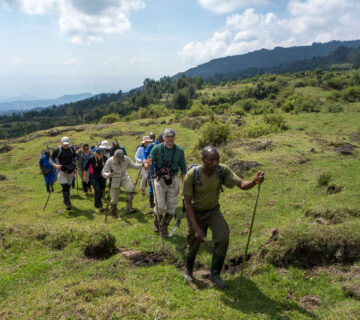
Bwindi Impenetrable Forest sits on a rugged mountainous system with elevation ranging roughly from 1,160 to over 2,600 meters. This means every trek involves continuous altitude variation, not just horizontal walking.
The terrain is defined by steep ridges, narrow valleys, and dense vegetation corridors. Unlike open savannah safaris in parks such as Queen Elizabeth National Park, movement here is vertical as much as it is horizontal.
Altitude affects breathing efficiency, muscle fatigue, and pacing. Even experienced hikers feel the cumulative effect of repeated ascents and descents during gorilla tracking.
Forest Density and Restricted Movement Lines
Bwindi is classified as an impenetrable forest for a reason. Vegetation is thick, layered, and constantly regenerating. Trails are narrow and often cut through tangled undergrowth, bamboo zones, and slippery leaf litter sections.
This density changes dramatically between rainy and dry seasons, affecting visibility, footing stability, and guide navigation efficiency.
Rainy Season Bwindi Trekking Conditions
Mud Saturation and Trail Instability
During rainy seasons, Bwindi trekking conditions become significantly more challenging due to saturated soil. Trails turn into mixed surfaces of clay, leaf sludge, and exposed roots.
This creates three key effects:
Foot placement becomes less predictable, requiring slower, more deliberate movement.
Energy expenditure increases due to reduced traction.
Stopping and restarting movement becomes physically demanding on steep sections.
Even short distances can feel longer because progress is interrupted by slipping risk and careful footing adjustments.
Vegetation Overgrowth and Reduced Trail Definition
Rain accelerates vegetation growth along trekking routes. This can partially obscure trail edges, making path definition less visually clear.
In some sections, hikers rely heavily on guide clearing rather than visible footpaths. This increases dependence on trekking staff and slows overall group movement pace.
Rainfall Impact on Trekking Flow
Rain in Bwindi is often intermittent rather than continuous, but when it occurs during a trek, it changes surface conditions rapidly. A dry trail can become slippery within minutes.
However, rainfall also has a stabilizing ecological effect. Gorillas tend to feed actively during or after rain, which can reduce search time in some cases.
Atmospheric Conditions in Wet Season
Rainy conditions create mist, low cloud cover, and high humidity. This reduces long-distance visibility but enhances immersion within the forest environment.
The forest feels quieter, denser, and more enclosed, which changes the psychological experience of trekking significantly.
Dry Season Bwindi Trekking Conditions
Improved Traction and Stable Footing
During drier months, trails in Bwindi become more compact and stable. Mud levels reduce significantly, especially on frequently used trekking paths.
This results in:
Faster movement between tracking points
Reduced slipping risk on steep slopes
More predictable foot placement across root and rock surfaces
However, dry does not mean flat or easy. The forest terrain remains steep and uneven regardless of season.
Reduced Vegetation Resistance
Dry conditions slightly reduce undergrowth density along trails. This improves visibility of terrain edges and makes directional movement easier to follow.
Guides can also maintain clearer trail routes, which improves overall trekking efficiency.
Higher Physical Exposure
While dry conditions improve mobility, they also increase physical exposure. Sunlight penetrates more open canopy gaps, and humidity levels can feel more concentrated during midday trekking.
This creates a different kind of physical strain compared to rainy season mud resistance.
Altitude Effects on Bwindi Trekking Experience
Oxygen Adaptation and Fatigue Levels
Bwindi’s altitude means oxygen levels are lower than lowland environments. This affects stamina even for fit travellers.
During steep ascents, breathing becomes more laboured, and pacing naturally slows. This is normal and expected, not a sign of poor fitness.
Muscle Load Distribution on Slopes
Because Bwindi trekking involves continuous elevation change, muscle fatigue accumulates differently than on flat hiking trails. Quadriceps, calves, and lower back muscles are heavily engaged throughout the trek.
Descending sections can be just as demanding as ascending due to braking force on slippery or uneven terrain.
Altitude Variation Between Tracking Zones
Different gorilla families occupy different elevation zones. Some groups are located in lower, more humid valleys, while others range into higher bamboo or montane forest zones.
This means trekking difficulty varies not just by season but by gorilla group location on the day of tracking.
Seasonal Comparison of Bwindi Trekking Conditions
Rainy Season Tactical Reality
Rainy season trekking in Bwindi Impenetrable National Park is defined by high ecological intensity and high physical resistance. Conditions include:
Deep mud sections
Slippery root networks
Rapid weather changes
Dense vegetation corridors
However, it also includes:
High forest productivity
Active gorilla feeding behaviour
Dramatic atmospheric visibility (mist and fog layering)
Dry Season Tactical Reality
Dry season trekking is defined by improved mobility but continued altitude challenge. Conditions include:
Stable ground traction
Reduced mud interference
Clearer trail visibility
Faster tracking movement
However:
Steep gradients remain unchanged
Heat exposure can increase mid-day fatigue
Forest density is still significant despite seasonal reduction
What Most Travelers Misjudge About Bwindi Conditions
Misunderstanding “Difficulty Levels”
A common misconception is that dry season equals easy trekking and rainy season equals extreme trekking. In reality, Bwindi difficulty is structural, not seasonal.
Altitude, slope gradient, and forest density are constant variables. Season only modifies surface conditions and movement efficiency.
Underestimating Micro-Climate Variability
Bwindi contains multiple micro-climates within short distances. One valley can be dry while the next ridge is wet and muddy.
This means trekkers often experience mixed conditions within a single journey, regardless of overall season.
Overfocusing on Weather Instead of Terrain
Weather is only one layer of trekking difficulty. Terrain structure and elevation change have a far greater impact on physical demand than rainfall alone.
Preparation Requirements Based on Bwindi Trekking Conditions
Footwear and Traction Strategy
Footwear choice is critical due to variable terrain. High-grip hiking boots with ankle support are essential for both rainy and dry seasons.
In wet conditions, traction stability becomes more important than comfort. In dry conditions, breathability and support balance become more relevant.
Physical Conditioning Expectations
Preparation should focus on endurance walking, incline training, and sustained cardio capacity rather than short bursts of fitness.
Bwindi trekking is a sustained effort activity, not a short hike.
Load Management and Energy Control
Carrying lightweight gear improves performance significantly due to continuous elevation changes. Energy conservation becomes important during long tracking durations.
Weather Layering Logic
Layering is necessary due to rapid micro-climate changes. Even in dry season, sudden rain showers or mist exposure can occur without warning.
Trekking Flow Dynamics Inside Bwindi Forest
Group Pacing and Guide Control
Trekking speed is controlled by guide interpretation of terrain and tracking signals. Movement is not fixed; it adapts to gorilla location updates and terrain conditions.
Stop-Start Movement Pattern
Bwindi trekking often follows a stop-start rhythm rather than continuous hiking. This is due to gorilla tracking pauses, terrain evaluation, and environmental reading.
Search Phase vs Encounter Phase
Trekking consists of two distinct phases: search phase and encounter phase. Conditions during search phase are heavily influenced by terrain and season, while encounter phase becomes stationary and observational.
Tactical Understanding of Bwindi Conditions
Bwindi trekking conditions rainy dry season should not be viewed as a binary system of easy versus hard. Instead, it is a shifting field environment where mud levels, altitude strain, vegetation density, and micro-climate variation interact continuously.
The forest does not simplify itself for visitors. It remains structurally complex year-round, with seasonal changes only adjusting how that complexity is experienced on foot rather than removing it.
Start Planning Your Next Trip To Africa
If you can picture yourself in one—or several—of these exceptional retreats, the next move is simple. We design fully tailored African safaris that bring these experiences together seamlessly, from private gorilla encounters to luxury lodges in the heart of the wild.
Every detail is carefully planned, so your journey feels effortless from start to finish. Reach out in whichever way suits you best, and let’s begin crafting your safari.
Start Planning