Kenya vs Tanzania for the Great Migration: Which Side of the Border Should You Be On?
The Great Migration is not a single “event” you book into a calendar slot—it is a living, moving ecosystem cycle that stretches across the plains of Serengeti National Park and Masai Mara National Reserve. More than a million wildebeest, joined by zebras and gazelles, move in a constant loop driven by rainfall, fresh grass growth, predator pressure, and survival instincts that have been repeated for thousands of years.
So when travelers ask whether Kenya or Tanzania is “better,” they are usually asking the wrong question. The real question is not about borders. It is about timing, behavior, density, and the kind of safari experience you actually want to feel on the ground.
The same migration looks completely different depending on where you stand and what month you visit.
The Migration Is One Ecosystem, Not Two Destinations
A Circular Journey That Ignores Borders
The herds do not recognize national boundaries. Their movement forms a clockwise loop through the Serengeti–Mara ecosystem.
Calving happens in the southern Serengeti plains in Tanzania, where nutrient-rich grasses support newborn survival. From there, herds drift west and north through the central and western Serengeti before crossing into Kenya’s Masai Mara when conditions peak around the Mara River. After grazing the northern plains, they eventually move back south into Tanzania as the rains return.
This means both countries are essential pieces of the same ecological story. The difference is not what happens—it is when it happens.
Why Timing Overrides Geography
A traveler in Tanzania at the right time can witness thousands of calves being born within days. A traveler in Kenya at the right time can see river crossings where crocodiles and strong currents create life-or-death tension.
Neither experience is “better.” They are simply different chapters of the same movement.
Tanzania: The Land of Scale, Birth, and Continuous Motion
The Southern Serengeti Calving Grounds
Between January and March, the southern plains of Serengeti National Park and the adjacent Ndutu region transform into one of the most biologically intense wildlife zones on Earth.
The grass here is short, nutrient-rich, and spread across wide open plains. This allows pregnant wildebeest to give birth in relative safety, where visibility is high and predators are easier to detect.
What makes this period extraordinary is not just the number of births, but the synchronization. Within a few weeks, hundreds of thousands of calves are born, overwhelming predator capacity and improving survival odds through sheer numbers.
Predator Pressure at Its Peak
This abundance of vulnerable newborns attracts a full range of predators.
Lions adjust their hunting patterns to follow nursery herds. Hyenas patrol the edges of calving zones. Cheetahs take advantage of open terrain for high-speed chases.
Unlike dramatic single moments such as river crossings, this is a continuous process of survival unfolding hour by hour across the landscape.
The Experience of Space and Movement
Tanzania’s Serengeti is vast. Even during peak migration periods, animals are spread across enormous distances.
This creates a safari style that feels expansive rather than concentrated. Game drives involve movement across landscapes rather than waiting at a single hotspot.
For many travelers, this sense of scale is what defines the Tanzania experience—it feels like watching a continent-sized ecosystem breathe and shift in real time.
Kenya: The Stage of Drama and High-Intensity Encounters
The Masai Mara and the River Bottleneck
From around July to October, herds begin to concentrate in Masai Mara National Reserve as they follow fresh grazing and approach the critical crossing points of the Mara River.
This is where the migration becomes visually dramatic.
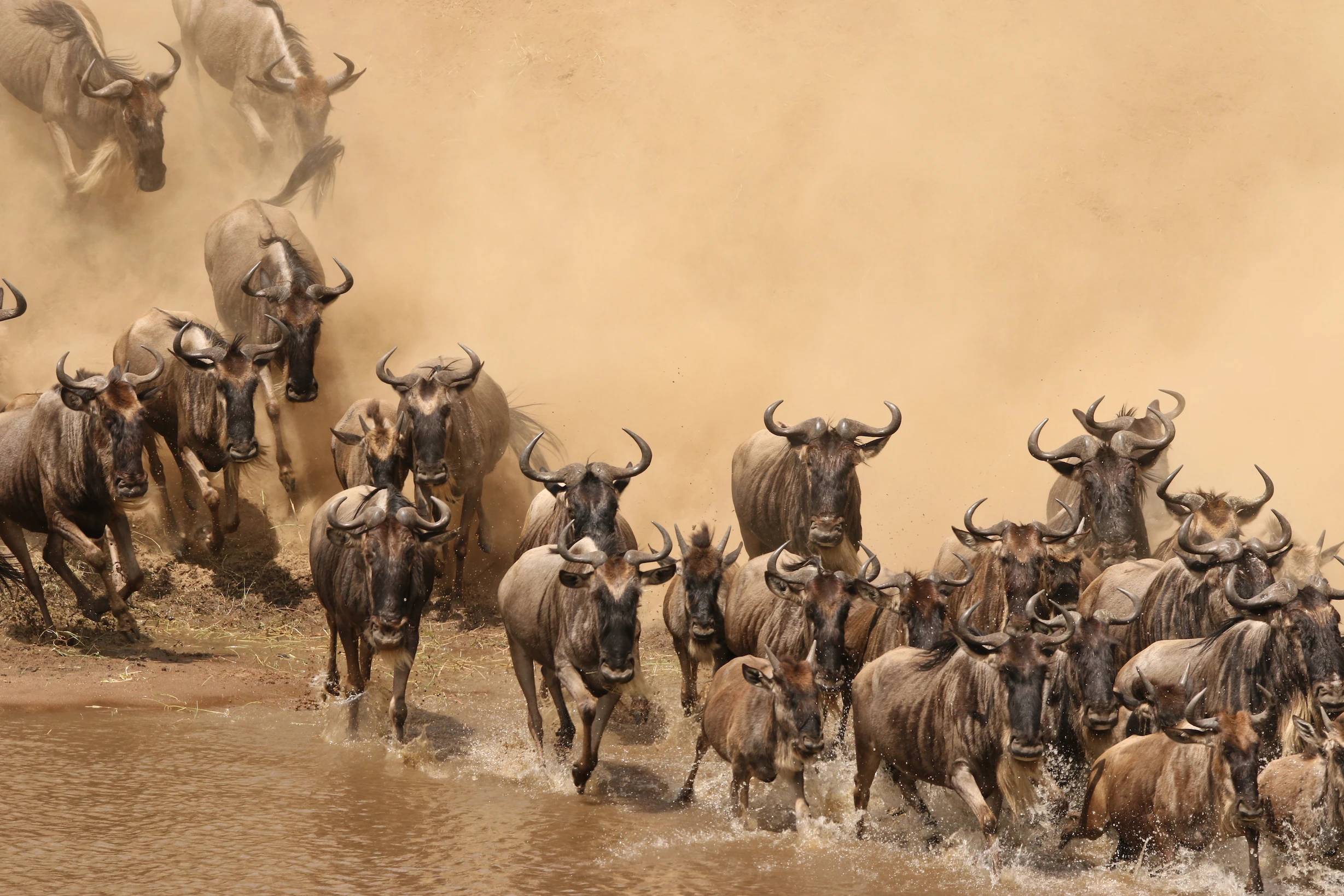
The river acts as both barrier and gateway. Wildebeest gather on the banks in large numbers, hesitating for hours or even days before attempting crossings. The tension is not scripted—it builds naturally from fear, instinct, and uncertainty.
River Crossings: Chaos and Survival
When crossings happen, they are fast, unpredictable, and chaotic.
Animals plunge into fast-moving water while crocodiles wait below the surface. Some make it across safely, others do not. The energy is intense, loud, and emotionally charged.
However, what many first-time visitors do not realize is that crossings are not scheduled events. You can wait for hours or days without seeing one, depending on herd movement and river conditions.
This unpredictability is part of both the excitement and frustration of the Kenya experience.
High Wildlife Density in a Compact Area
The Masai Mara is smaller than the Serengeti, which means animals are more concentrated.
This increases the likelihood of multiple predator sightings in a short period of time. Lions, cheetahs, and hyenas are frequently encountered due to dense prey availability.
Game drives feel faster-paced and more “event-driven,” with frequent sightings across shorter distances.
The Reality of Vehicle Density
Because of its global popularity during migration season, the Masai Mara can experience significant vehicle congestion at river crossing points.
This does not diminish the wildlife experience, but it changes its atmosphere. Instead of solitude, you often share sightings with multiple vehicles positioned around key action zones.
Kenya vs Tanzania: Experience Differences That Actually Matter
Scale Versus Concentration
Tanzania delivers scale. You are moving through vast landscapes where wildlife is spread across horizons.
Kenya delivers concentration. You are positioned in smaller zones where wildlife density is high and action is frequent.
Continuous Behavior Versus Peak Moments
Tanzania is about continuous ecological behavior—calving, grazing, migration movement, and predator tracking over extended periods.
Kenya is about peak moments—river crossings, ambushes, and short bursts of high-intensity action.
Movement Versus Waiting
In Tanzania, safaris are often mobile, following herds across large areas.
In Kenya, safaris often involve waiting at strategic points like river crossings for events to unfold.
Timing Is Everything: When Each Country Wins
January to March: Tanzania Dominates
This is calving season in the southern Serengeti. If your goal is newborn wildlife, predator interactions, and continuous herd density, Tanzania is unmatched during this period.
June to July: Transition Phase
Herds move through central and western Serengeti. This is a transitional phase where movement dominates over spectacle.
July to October: Kenya Peak Drama
This is the famous Mara River crossing season in Masai Mara National Reserve. If you want dramatic tension and unpredictable crossings, Kenya becomes the focal point.
November to December: Return South
Herds begin moving back into Tanzania as rains shift southward, reactivating grazing areas.
Safari Logistics and Travel Experience
Tanzania: Broader and Slower-Built Safaris
Tanzania safaris often involve longer itineraries covering multiple ecosystems, including crater regions like Ngorongoro Conservation Area.
Travel distances are longer, but ecological diversity is higher.
Kenya: Shorter and More Focused Itineraries
Kenya safaris are often shorter, with a strong focus on the Masai Mara.
This makes them easier to integrate into limited travel windows.
Accessibility and Comfort
Kenya generally offers slightly easier logistics for quick access to migration viewing.
Tanzania requires more travel time but offers broader landscape immersion.
Crowd Dynamics and Viewing Atmosphere
Tanzania: Open Space Viewing
Even during peak migration periods, the Serengeti’s size allows for dispersed viewing.
You often have more space to observe animals without crowding.
Kenya: High-Intensity Viewing Zones
River crossings can attract many vehicles, creating concentrated viewing clusters.
This adds excitement but reduces exclusivity at key moments.
What Most Travelers Don’t Realize
The biggest misconception is that Kenya and Tanzania are competing for “best migration experience.”
In reality, they are complementary ecosystems hosting different phases of the same movement.
A traveler choosing between them is not choosing better wildlife—they are choosing which behavioral narrative they want to experience.
Tanzania offers the long, unfolding story of life, survival, and movement across vast plains.
Kenya offers concentrated moments of tension where survival decisions happen in seconds at river edges.
Both are valid. Both are extraordinary. The real decision is not about geography—it is about rhythm.
Start Planning Your Next Trip To Africa
If you can picture yourself in one—or several—of these exceptional retreats, the next move is simple. We design fully tailored African safaris that bring these experiences together seamlessly, from private gorilla encounters to luxury lodges in the heart of the wild.
Every detail is carefully planned, so your journey feels effortless from start to finish. Reach out in whichever way suits you best, and let’s begin crafting your safari.
Start Planning