Wilson Airport Nairobi: Everything You Need to Know About Kenya’s Safari Gateway
Wilson Airport is one of the most important but least understood parts of a Kenya safari journey. While international travellers usually arrive through Jomo Kenyatta International Airport, the real operational hub for safari travel is Wilson Airport in Nairobi. This is where most bush flights depart for national parks, conservancies, and remote airstrips across Kenya.
For destinations such as the Masai Mara National Reserve, Wilson Airport is not just a transit point—it is the gateway that connects urban Nairobi to the wilderness within hours.
What Wilson Airport actually is
Wilson Airport is a domestic aviation hub located just a short distance from central Nairobi. Unlike the international airport, it is smaller, more functional, and dedicated almost entirely to regional and safari flights.
It serves as the base for light aircraft operations that connect travellers to Kenya’s key wildlife regions. This includes scheduled bush flights, charter services, and private safari aviation.
The airport is named after Florence and Michael Wilson, early aviation pioneers in Kenya, and has evolved into one of the busiest general aviation airports in Africa.
Why Wilson Airport matters for safari travel
Wilson Airport is the operational backbone of Kenya’s safari industry. Almost every high-end safari itinerary that includes flying between parks relies on this airport.
From here, travellers are flown directly into airstrips located inside or near national parks and conservancies. These include the Masai Mara, Amboseli, Samburu, Laikipia, Tsavo, and many private conservancies.
Without Wilson Airport, Kenya’s multi-park safari circuits would be significantly slower and less efficient.
It is the point where international arrival transitions into wilderness logistics.
How the airport fits into your arrival in Nairobi
Most international travellers land first at Jomo Kenyatta International Airport. From there, they either transfer directly to Wilson Airport or stay overnight in Nairobi before continuing their safari.
The transfer between the two airports is relatively short in distance but can vary in time depending on Nairobi traffic conditions.
Because of this, safari itineraries are often designed around buffer time to ensure smooth connection between international arrival and domestic departure.
What the experience at Wilson Airport feels like
Wilson Airport is very different from a commercial international terminal.
It is smaller, more informal, and highly operational. Instead of long queues and large crowds, you will typically find safari passengers, pilots, crew members, and ground staff moving efficiently between aircraft and waiting areas.
The environment feels more like a logistics hub than a traditional airport terminal.
You board small aircraft directly from the tarmac, often walking a short distance from the terminal building to your plane.
Aircraft types and safari flights
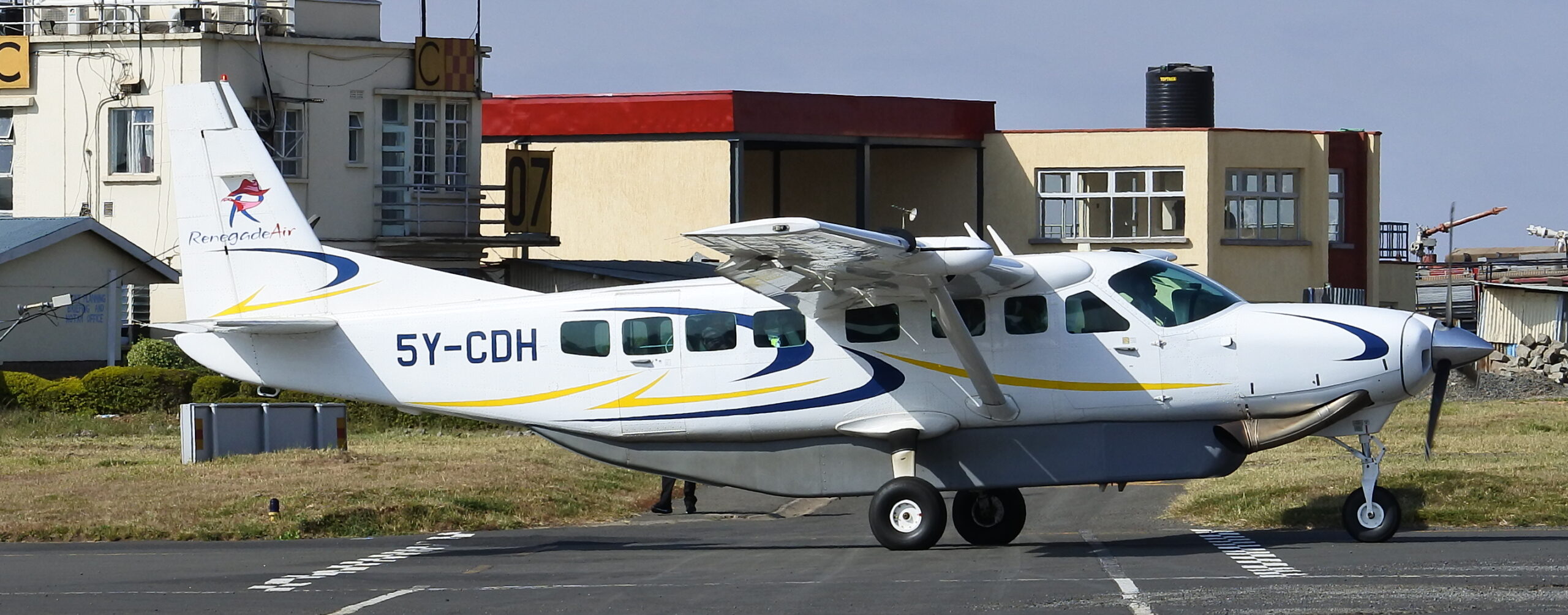
The aircraft operating from Wilson Airport are typically small propeller planes designed for short takeoff and landing capabilities.
These aircraft are used because many safari airstrips in Kenya are remote and have unpaved runways.
Common aircraft types include light twin-engine planes that carry between 6 and 12 passengers.
Flights are arranged to maximize efficiency, often combining passengers heading to nearby destinations on the same route.
The Nairobi to Masai Mara connection
One of the most important routes from Wilson Airport is the Nairobi to Masai Mara corridor.
Flights on this route take approximately 45 minutes to 1 hour depending on the specific airstrip.
Instead of landing at a single central airport, aircraft fly directly into multiple small airstrips positioned near lodges and conservancies.
This is what makes the Masai Mara system so accessible compared to other safari regions in Africa.
Once you land, you are typically met by safari guides and transferred directly into the reserve or conservancy for your first game drive.
Inside the Masai Mara ecosystem connection
In regions such as the Masai Mara ecosystem, Wilson Airport acts as the launch point for accessing one of the most wildlife-dense areas in Africa.
Once airborne, the landscape quickly transitions from urban Nairobi to agricultural land, and then into open savannah as you approach the reserve.
This rapid shift is part of what makes safari travel in Kenya so efficient—you move from city to wilderness in under an hour of flying.
Northern Kenya connections from Wilson Airport
Wilson Airport is also the departure point for northern Kenya safari regions such as Laikipia, Samburu, Lewa, and surrounding conservancies.
These regions are more remote and spread out, making air travel essential for practical access.
Flights to northern Kenya are slightly longer than Masai Mara routes but still significantly faster than road travel.
This connectivity allows travellers to combine multiple ecosystems within a single itinerary without long overland transfers.
Check-in process and passenger flow
The check-in process at Wilson Airport is straightforward but different from commercial airports.
Passengers typically arrive, confirm their flight details with the operator, and proceed through a simplified security and boarding process.
Luggage is weighed and loaded directly into aircraft storage compartments.
Because of strict weight limits, soft-sided bags are required, which is standard across all safari flights in Kenya.
Timing and scheduling reality
Flights from Wilson Airport operate on fixed morning and afternoon schedules, but they are more flexible than commercial airline timetables.
Weather conditions, passenger routing, and aircraft availability can occasionally influence departure times.
Morning flights are generally preferred because they offer more stable flying conditions and better coordination with safari game drive schedules upon arrival.
Why Wilson Airport is central to safari efficiency
The importance of Wilson Airport is not just logistical—it is structural.
It enables Kenya’s safari system to function as a multi-destination network rather than a linear travel route.
Without it, travellers would spend significantly more time on roads between parks.
With it, they can experience multiple ecosystems in a single journey with minimal travel fatigue.
This is especially important for itineraries that include combinations such as Nairobi, Masai Mara, and northern Kenya conservancies.
The transition from city to wilderness
One of the most defining aspects of departing from Wilson Airport is the immediate transition experience.
Within minutes of takeoff, Nairobi’s urban environment fades into agricultural landscapes, and then gradually into wild terrain.
By the time you approach your destination airstrip, you are already visually immersed in safari environments.
This creates a psychological shift that marks the beginning of the safari experience rather than just transport.
Arrival experience at safari airstrips
Flights from Wilson Airport typically land at small bush airstrips located near lodges or inside conservancies.
These airstrips are simple, functional, and surrounded by natural landscapes.
There are no large terminals or infrastructure—just a landing strip and safari vehicles waiting for guests.
In many cases, wildlife may even be visible near the airstrip, reinforcing the sense that you have already entered the ecosystem.
Why Wilson Airport is often underestimated
Most travellers focus on international airports and safari destinations, but Wilson Airport is the critical link that connects the entire system.
It is where the logistical complexity of safari travel is managed efficiently and quietly.
Without it, Kenya’s ability to support fast, multi-region safari circuits would not be possible.
It is not a tourist attraction in itself, but it is central to nearly every safari journey in the country.
The real role of Wilson Airport in safari design
Wilson Airport functions as the operational bridge between international arrival and wilderness immersion.
It compresses geography, reduces travel time, and enables flexible routing across Kenya’s diverse ecosystems.
For most travellers, it is the point where planning becomes reality and the safari experience truly begins.
Start Planning Your Next Trip To Africa
If you can picture yourself in one—or several—of these exceptional retreats, the next move is simple. We design fully tailored African safaris that bring these experiences together seamlessly, from private gorilla encounters to luxury lodges in the heart of the wild.
Every detail is carefully planned, so your journey feels effortless from start to finish. Reach out in whichever way suits you best, and let’s begin crafting your safari.
Start Planning